
.png)
Turning Citizen Reports into Compliance Data: How Utilities Can Master Public Service Quality Standards (ESG & ARERA).
For companies managing public services—such as Waste Management, Water, and Street Lighting—the landscape has changed radically. Today, it is no longer enough to simply "empty the bins" or "fix the pipe". Today, companies must measure, report, and guarantee increasingly stringent Public Service Quality Standards.
The regulatory authority (ARERA) imposes precise obligations regarding technical and contractual quality (such as the TQRIF for waste management), while investors and stakeholders demand robust ESG (Environmental, Social, Governance) reports. In this context, the citizen is no longer just a passive user: they are the primary judge of corporate performance.
The challenge for Utility companies is twofold:
Bridging the gap between delivered quality (what the spreadsheets say) and perceived public service quality (what citizens see on the street).
Demonstrating timeliness and transparency to avoid penalties and reputational damage.
IOparteciPA steps into this workflow as a Compliance and monitoring tool, transforming citizen reports into certifiable data for meeting Service Level Agreements (SLAs).
From Complaints to Compliance with Public Service Quality Standards
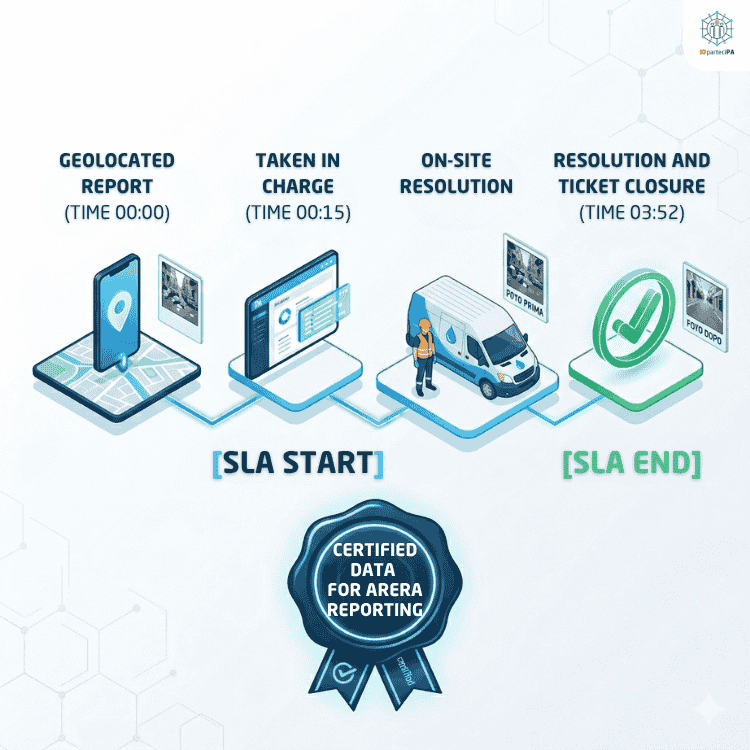
Managing reports effectively is a fundamental parameter for contractual quality. By using IOparteciPA, a Utility company can automate the data collection required for regulatory reporting:
Acknowledgement Time: The system tracks the exact moment a report is opened.
Resolution Time: Closing the ticket provides definitive data on intervention speed, which is essential for calculating compliance with Public Service Quality Standards.
Geolocation of the Fault: Geotagged photos eliminate disputes regarding the location or existence of the problem, offering objective "before and after" proof of the intervention.
There is no need for expensive call centres to gather this data: the platform does it automatically, reducing operational costs and improving reporting accuracy.
The ESG Factor: Governance and Sustainability
Adopting an active listening platform directly impacts the company's ESG Rating, touching upon all three pillars:
Environment: Faster interventions on water leaks or fly-tipping (illegal waste dumping) reduce environmental impact and urban decay.
Social: The community is offered a tool for inclusion and engagement, improving the relationship with the local territory.
Governance: The platform guarantees maximum transparency and process traceability—key elements for corporate responsibility and sustainability reporting (CSRD).
SDG 17: Building Winning Public-Private Partnerships
Goal 17 of the UN Agenda invites us to "Strengthen the means of implementation and revitalize the global partnership". IOparteciPA acts as the technological bridge uniting the three key actors in the territory: the Local Council (which controls), the Utility (which operates), and the Citizen (who uses the service).
Instead of working in silos, often in conflict, the platform enables fluid collaboration. The citizen reports, the Utility resolves, and the Council monitors. All on a single, shared dashboard. This reduces litigation between the Authority and the Operator and builds a reputation for efficiency that is worth more than a thousand advertising campaigns.
For a modern Utility, transparency is not a risk. It is the ultimate competitive advantage.

Snap it. Send it. Solved.
Marco Bonifaccino
Founder & Project Leader of IOparteciPA


Comments